
A better way forward
What makes the SBTH architecture unusual is that it was not designed primarily around growth metrics, engagement loops, or technological fashion. It was designed around editorial control, clarity, durability, and long-term stewardship. ProcessWire functions as the editorial backend, but the public-facing site is increasingly becoming something closer to a published artifact than a continuously running application. Updates are deliberate rather than constant. The publishing process is curated rather than automated. The organization maintains direct ownership over the final output, while minimizing runtime behavior and reducing dependence on opaque systems operating in the background.
In that sense, the move toward a true static build is not a radical departure from the original direction of the project. It is more like the completion of a logic that was already present from the beginning.
Read more about the philosophy behind this approach.
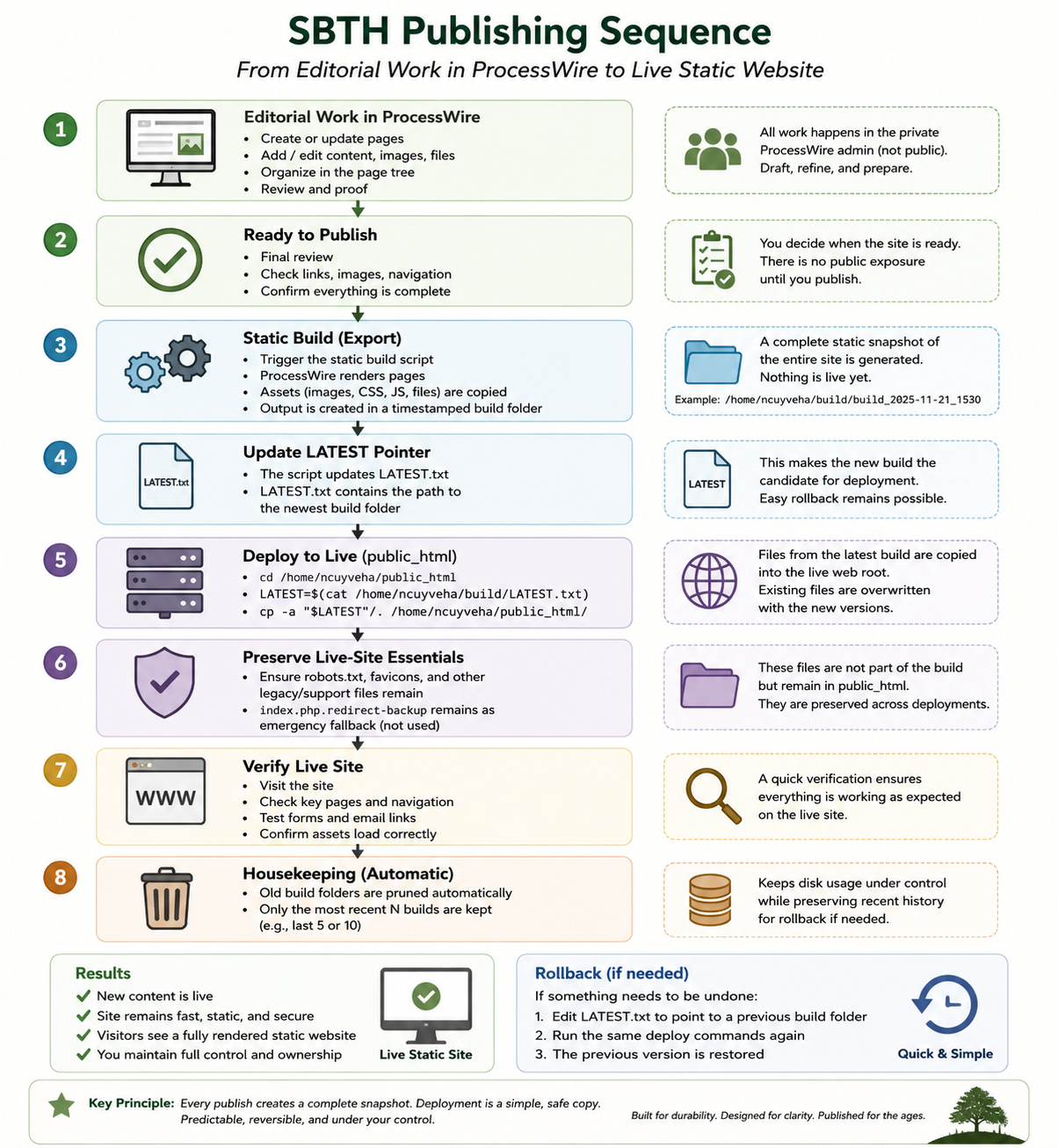
A fully static publishing layer aligns remarkably well with the broader goals of SBTH. It reduces the number of moving parts publicly exposed to the internet, eliminates the live CMS attack surface, removes dependence on a public database, simplifies hosting, improves performance, and makes rollback and archival preservation dramatically easier. Just as important, it creates predictability. The rendered site becomes stable, inspectable, and understandable in a very direct way.
That last quality matters more than many people realize. Modern websites often feel like living systems that can fail unpredictably because of software updates, plugins, third-party integrations, databases, or unseen dependencies. A static publishing model changes the psychological relationship between the editor and the technology. The site stops feeling like a machine that constantly demands vigilance and instead begins to feel like a durable publication generated from known source material. The mental burden drops substantially when the system is mostly files, mostly deterministic, and mostly transparent.
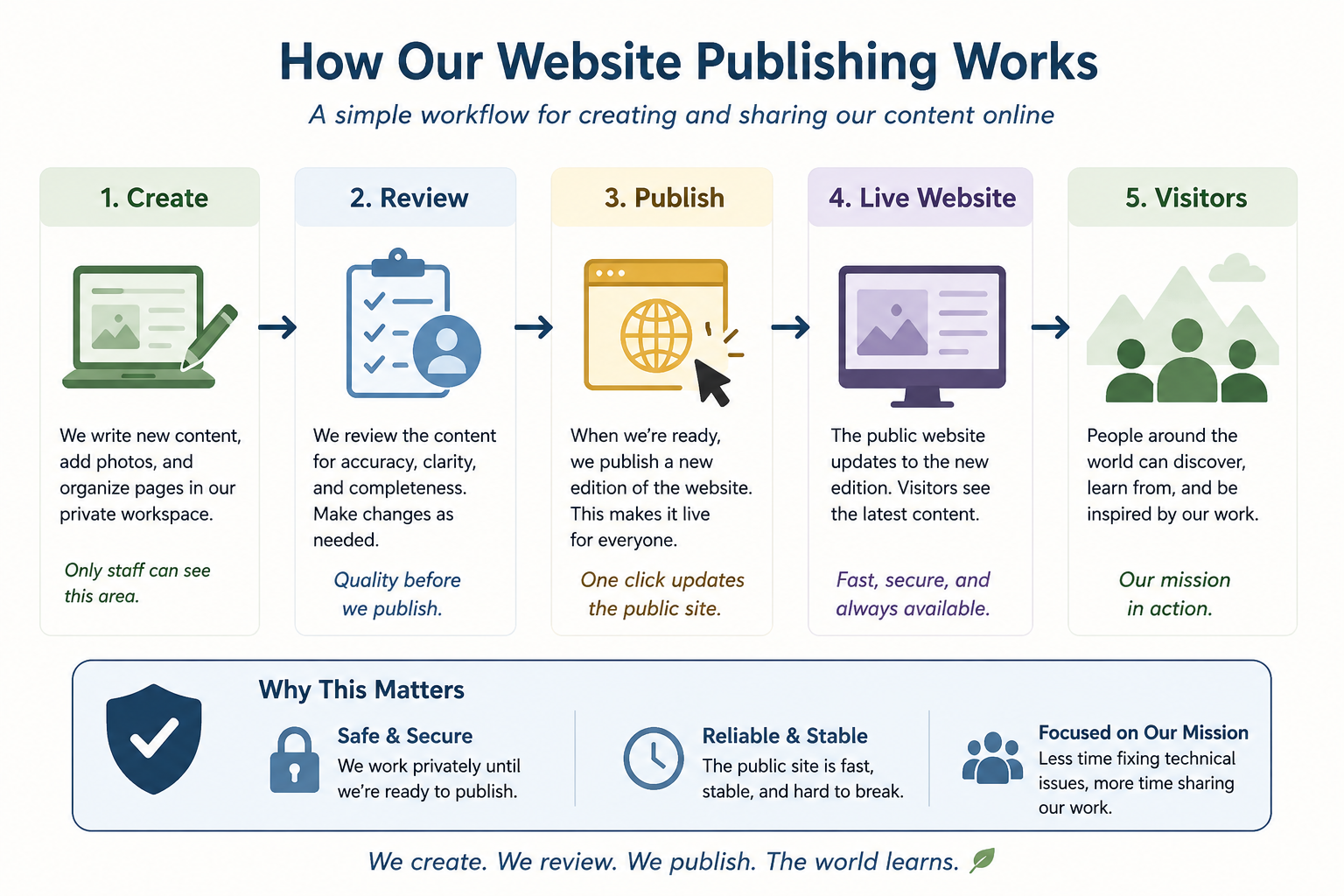
This approach also fits the temperament and editorial style behind SBTH itself. The organization emphasizes careful observation, long-form writing, habitat documentation, photography, educational resources, and stable reference material. It has shown very little interest in algorithmic engagement systems or the endless churn of reactive publishing. In practice, SBTH resembles a digital field journal, archive, educational publication, and institutional record far more than it resembles a continuously interactive web application. That is precisely the kind of environment where static systems excel.
None of this requires ideological purity about “static” technology. Dynamic services can still exist where they genuinely serve a purpose. A forum, mailing list, Mastodon integration, or other isolated services can operate alongside the static publishing layer without undermining the overall architecture. The important distinction is between the core publishing system and the peripheral services attached to it.
There are also substantial practical advantages that visitors immediately perceive, even if they cannot identify the technical reasons behind them. A fully static site served directly by the web server eliminates enormous layers of delay and complexity. There are no database queries required to generate a page, no PHP execution on every request, no plugin overhead, no runtime rendering pipeline, no session management, and very little JavaScript. The server is mostly doing one simple thing: serving HTML files, CSS files, and images. That simplicity produces extraordinary efficiency.
The result is a site that feels calm, responsive, dependable, lightweight, and readable. Those qualities are not accidental. They emerge from the combination of static serving, restrained design, disciplined structure, carefully prepared images, limited dependencies, and the absence of advertising or tracking systems competing for attention and resources.
There is also a deeper philosophical alignment between the technical architecture and the editorial philosophy that has guided SBTH from the start. The site favors durable structures over reactive systems, curation over algorithms, direct ownership over platform dependence, and understandable mechanisms over opaque layers of abstraction. Many contemporary websites behave more like software applications pretending to be publications. SBTH, by contrast, is moving closer to being an actual publication again — one designed to endure, to remain understandable, and to serve as a stable record rather than a constantly shifting stream.