
In the early years of the web, most websites consisted of ordinary files stored on a server. When a visitor requested a page, the server simply delivered that file. A web page existed as an actual document — an HTML file sitting on a computer somewhere. The system was relatively simple, understandable, durable, and efficient. Many sites could operate for years with minimal maintenance because there were comparatively few moving parts behind the scenes.
Over time, however, the web shifted toward dynamic generation. Instead of serving completed files directly, websites increasingly began constructing pages in real time whenever a visitor requested them. A modern website often assembles each page dynamically using databases, server-side programming languages, templates, plugins, APIs, analytics systems, advertising systems, personalization layers, and other interconnected components. To the average visitor this process is mostly invisible, but a large amount of activity may occur behind the scenes every time a single page loads.
Dynamic systems became dominant for understandable reasons. They solved real problems and made many important capabilities possible. Content management systems allowed non-technical editors to publish material more easily. Databases made large archives searchable and easier to organize. Multi-user systems allowed organizations to collaborate. Dynamic systems also supported e-commerce, user accounts, comments, interactive tools, and personalized experiences. In many ways, the rise of dynamic websites reflected the growing ambitions of the web itself.
At the same time, this shift introduced a great deal of hidden complexity. Modern websites often require continuous software maintenance, security updates, database management, plugin compatibility testing, server-side processing, and ongoing technical oversight. A site that appears visually simple to visitors may actually depend on dozens of interacting systems operating continuously behind the scenes. As complexity increased, so did energy use, maintenance requirements, security vulnerabilities, and dependence on specialized technical expertise.
The distinction between static and dynamic websites is therefore not merely technical. It reflects different assumptions about complexity, ownership, maintenance, energy use, and long-term sustainability.
Most users are never asked to think about this infrastructure. The complexity is hidden from view. Yet it still affects the durability, efficiency, security, and independence of the systems people rely upon. It also changes the relationship organizations have with their own websites. Many groups no longer truly control their publishing infrastructure. Instead, they depend on layers of hosted services, subscription platforms, proprietary ecosystems, advertising systems, analytics frameworks, and outside technical support simply to maintain an online presence.
The distinction between static and dynamic websites is therefore not merely technical. It reflects different assumptions about complexity, ownership, maintenance, energy use, and long-term sustainability.
A static site serves completed pages directly to visitors. A dynamic site constructs pages at the moment they are requested. Each approach has advantages and disadvantages. Static sites are generally faster, simpler, more secure, more energy efficient, easier to archive, and less dependent on complex infrastructure. However, traditional static sites can also be difficult to maintain if every page must be edited manually. Dynamic systems make editing, organization, and large-scale publishing much easier, but they often introduce substantial complexity and ongoing maintenance burdens.
The approach used for the Saving Birds Thru Habitat website attempts to combine the advantages of both systems while avoiding many of the disadvantages of either. Internally, the organization uses a dynamic content management system during the editorial process. This allows articles, field notes, resources, images, newsletters, and related materials to be organized efficiently using templates, structured fields, and reusable systems. Editors can work within a flexible publishing environment without manually constructing every page.
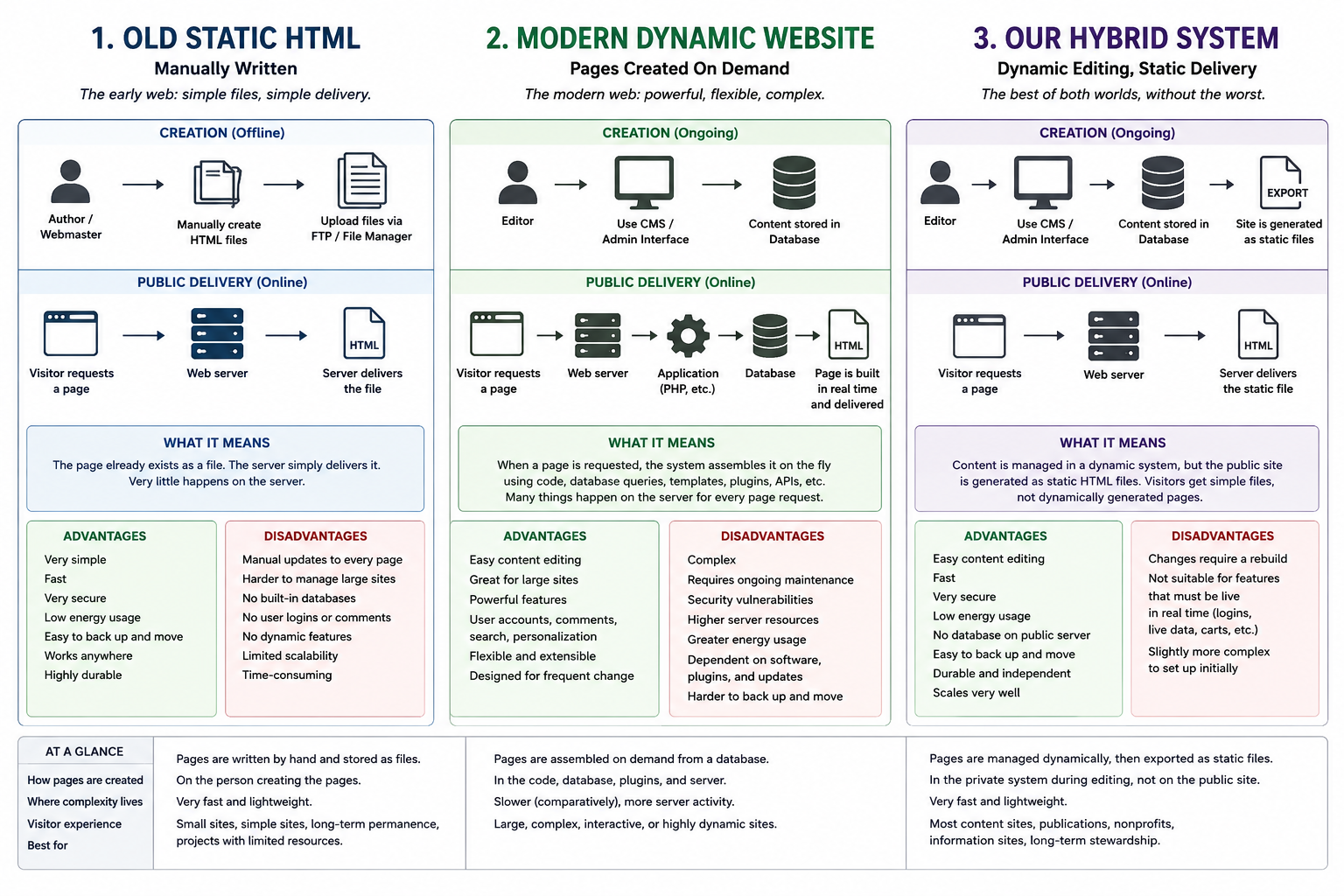
At the same time, the public-facing website is exported as static HTML files. Visitors are served completed pages directly rather than relying on a live database-driven system operating continuously on the public server. In practice, this means the site retains many of the organizational advantages of a modern content management system while preserving many of the strengths of the earlier web: simplicity, speed, durability, security, portability, and reduced infrastructure requirements.
Complexity should exist where it serves a real purpose, not simply because modern systems assume it must exist everywhere.
This is not an attempt to reject modern technology or return nostalgically to the early internet. The goal is not to abandon useful tools, but to use them selectively and carefully. Dynamic systems are employed where they genuinely improve the editorial process, while unnecessary layers of public-facing complexity are reduced whenever possible.
That decision reflects a broader philosophy running throughout the organization’s work. Complexity should exist where it serves a real purpose, not simply because modern systems assume it must exist everywhere. Tools should support human beings rather than requiring human beings to reorganize themselves around the needs of the tool. In the same way that habitat restoration can be integrated into ordinary human life rather than treated as something abstract and institutional, digital infrastructure can also be designed to remain understandable, durable, and connected to human purposes.
The intention is to create systems that remain calm, stable, and maintainable over long periods of time. Rather than pursuing novelty, optimization, or endless technological escalation, the goal is to build a publishing environment that supports stewardship, autonomy, and long-term care — both for the organization itself and for the information it hopes to preserve and share.